-
Title
-
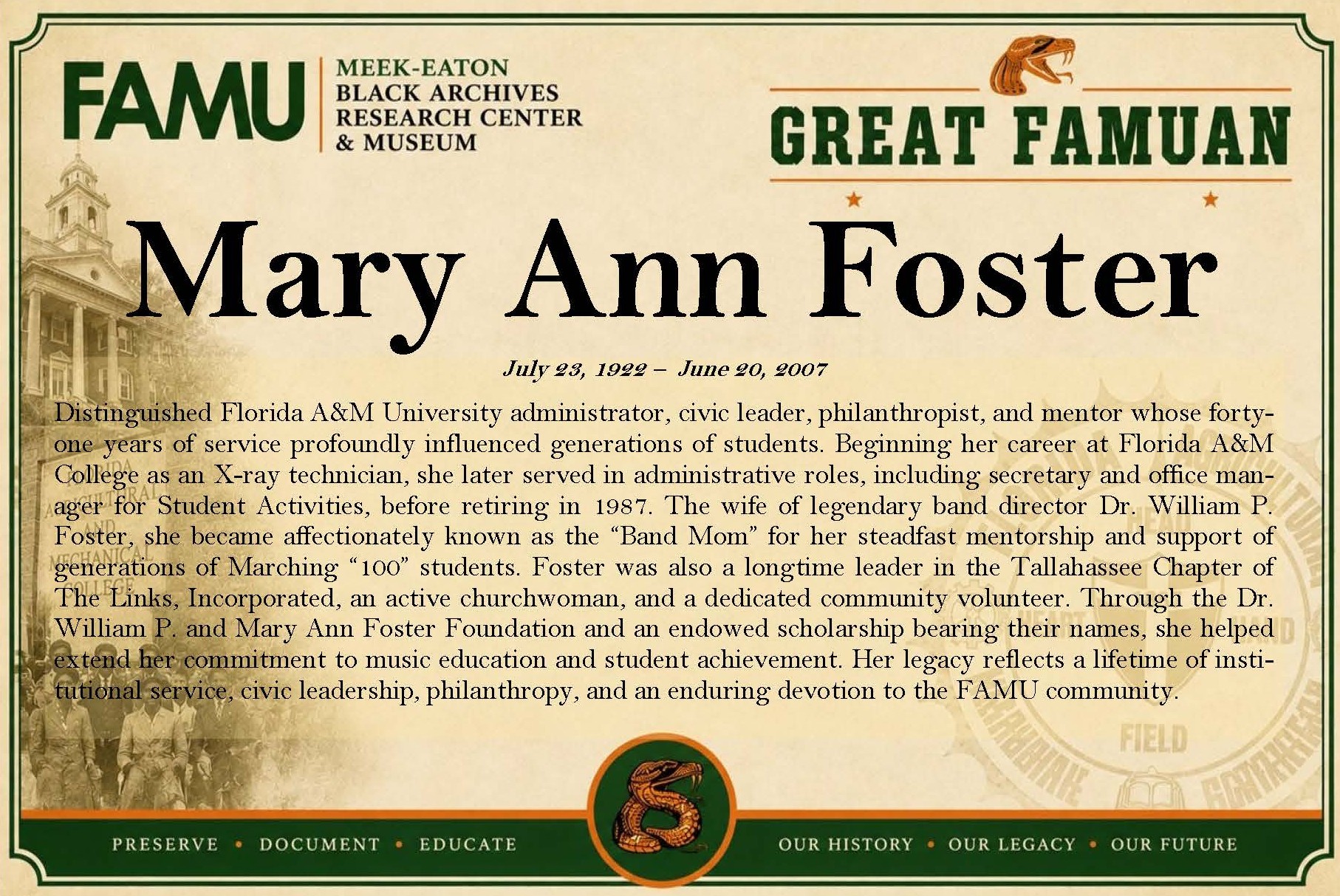
Mary Ann Foster
-
Alternative Title
-
Ann
-
Birth Date
-
July 23, 1922
-
Transition Date
-
June 20, 2007
-
Category
-
Faculty
-
Affiliation to FAMU
-
Marching 100
-
Life at FAMU
-
Affectionately known as “Ann,” devoted more than four decades of professional service to Florida Agricultural and Mechanical College and Florida A&M University. As a staff member, administrator, student mentor, philanthropist, and steadfast supporter of the University's celebrated band program, Foster became a familiar and influential presence in campus life. Her forty-one years of service reflected an enduring commitment to students and to the institutional mission of Florida A&M.
Foster's professional relationship with the institution began when she joined Florida A&M College as an X-ray technician. Her medical training prepared her to contribute to the health and welfare of the campus community during an era when historically Black institutions provided essential professional and health-related services to African Americans who faced widespread discrimination within segregated systems.
Her responsibilities subsequently expanded beyond health care when she became secretary to Dr. Leonard H. B. Foote. She later served as secretary and office manager for Student Activities, a position that placed her at the center of student life and brought her into sustained contact with generations of FAMU students, student leaders, organizations, faculty, and administrators.
Student Activities represented an important dimension of the collegiate experience. Beyond formal academic preparation, student organizations provided opportunities for leadership development, civic engagement, cultural expression, professional preparation, and community building. Foster's administrative work helped sustain this environment and positioned her as an important source of institutional knowledge and guidance.
Her influence, however, extended beyond the formal responsibilities of her position. Students came to recognize Foster as an approachable and dependable mentor who provided encouragement, counsel, and practical assistance. Through these relationships, she participated in the informal networks of mentorship and care that have historically been particularly important within HBCUs.
Foster's forty-one years at Florida A&M encompassed an extraordinary period of institutional development. She witnessed the transition from Florida A&M College to Florida A&M University, the social transformations of the Civil Rights era, the expansion of academic and student programs, and the continued development of FAMU's national reputation. Through these changes, Foster provided continuity across generations of University life.
Her contributions were recognized by numerous areas of the institution, including Student Affairs, Student Activities, the Student Government Association, and the University Band. She also received recognition from FAMU President Frederick S. Humphries. These honors reflected the breadth of her service and demonstrated that her influence extended across administrative, student, and cultural areas of the University.
One of the most enduring dimensions of Foster's relationship with FAMU developed through the University's music program. She was married to Dr. William P. Foster, whose leadership as director of bands transformed the FAMU band program and the Marching “100” into an internationally recognized collegiate musical institution. Yet Mary Ann Foster's role within the band's history developed an identity and significance of its own.
Generations of band members affectionately knew her as the “Band Mom.” The designation reflected the encouragement, counsel, hospitality, and personal support she provided to students. She understood that members of the band were not simply performers but young people balancing rigorous academic responsibilities with the considerable demands of musical preparation, rehearsals, travel, and performance.
For students living away from their families, Foster often represented a source of stability and encouragement. Her relationship with band members reflected a form of mentorship grounded in care and personal investment. Through this work, she contributed to the culture of discipline, family, and institutional pride that became closely associated with the Marching “100.”
Her contribution was sometimes described through the phrase “the force behind the Man Behind the Baton,” acknowledging her steadfast partnership with Dr. Foster throughout his legendary tenure. The description recognizes an important dimension of institutional history: prominent achievements are frequently sustained by networks of individuals whose contributions occur outside the most visible positions of leadership.
Foster's role should therefore not be understood solely through her marriage to Dr. William P. Foster. Her own forty-one-year professional career, direct relationships with students, administrative responsibilities, and longstanding commitment to student development established an independent record of service to the University. Her association with the band expanded that record rather than defining its entirety.
After retiring from Florida A&M University in 1987, Foster remained connected to the institution and its students. Her commitment to the band and music education continued through philanthropy and efforts to preserve the Foster legacy for future generations.
The Dr. William P. and Mary Ann Foster Foundation was established to promote music education, support the Marching “100,” and preserve the historical legacy associated with the Fosters and FAMU's band program. By attaching her name and resources to educational philanthropy, Foster helped extend her commitment to students beyond the generations she had personally known.
The William P. and Mary Ann Foster Endowed Scholarship Fund similarly transformed the Fosters' dedication to students into a lasting mechanism for educational opportunity. Scholarship assistance for band students helped ensure that financial need would not unnecessarily prevent talented young musicians from pursuing their education and participating in the University's musical tradition.
Foster's FAMU legacy consequently encompasses professional service, student mentorship, music, philanthropy, and institutional stewardship. Her story also represents the often underrecognized contributions of staff members to the development of historically Black colleges and universities. Staff professionals frequently provided the organizational continuity, student support, institutional knowledge, and personal relationships upon which campus communities depended.
Mary Ann Foster's significance to Florida A&M cannot be measured solely by her official titles. It resides equally in the relationships she cultivated, the students she encouraged, the programs she supported, and the institutional traditions she helped sustain. For generations of Rattlers—particularly members of the Marching “100”—she represented a personal connection to the larger FAMU family.
Through forty-one years of service and a lifetime of continued commitment, Mary Ann Duncan Foster established a distinguished place within the history of Florida A&M University. As an administrator, mentor, “Band Mom,” philanthropist, and institutional advocate, she exemplified a philosophy of service rooted in care for students and dedication to the University. Her legacy remains intertwined with both the everyday life of FAMU and the extraordinary musical tradition she helped nurture and sustain.
-
Life Bio
-
Professional administrator, civic leader, philanthropist, volunteer, arts advocate, wife, and mentor whose life reflected an enduring commitment to education and community service. Born in Shreveport, Louisiana, she was educated in the public schools of Shreveport and Kansas City, Kansas, developing interests in the arts, public speaking, and academic achievement from an early age.
As a young woman, Foster distinguished herself through both ballet and oratorical competition. She earned numerous awards and honors, demonstrating abilities that reflected discipline, confidence, artistic expression, and communication. These formative experiences anticipated the cultural engagement and public service that would characterize her adult life.
Foster continued her education at Wayne State University and pursued professional training as an X-ray technician at Kansas City General Hospital. Her preparation in health care placed her within a generation of African American women who entered expanding professional fields during a period when both racial and gender discrimination restricted employment opportunities.
Her professional training as an X-ray technician was particularly significant within the historical context of segregated American health care. African American health professionals and support personnel frequently worked within institutions serving Black communities that had limited access to white hospitals and medical facilities. Their work contributed to the development of professional Black health-care networks and expanded access to medical services.
Foster's professional life eventually broadened from health care into administration. Her skills in organization, communication, and institutional management enabled her to assume responsibilities that placed her in direct contact with educators, administrators, students, and community organizations. Across her career, she developed a reputation for professionalism coupled with an unusual capacity for building personal relationships.
Her service also included responsibilities as secretary to the William J. Gunn Medical Association, maintaining an important connection to the health-related professional community. This work complemented the medical training with which she had begun her career and reflected the breadth of her administrative experience.
Civic leadership formed another important dimension of Foster's life. She maintained a longstanding relationship with the Tallahassee Chapter of The Links, Incorporated, an organization of African American women devoted to friendship and service. The Links became an important national vehicle through which Black professional women supported education, health initiatives, cultural enrichment, youth development, international awareness, and community advancement.
Foster served the Tallahassee Chapter in significant leadership capacities, including terms as president and secretary. Her willingness to assume organizational responsibility demonstrated that her commitment extended beyond membership to active stewardship. Over decades of participation, she contributed to the chapter's tradition of organized service within the Tallahassee community.
Her longevity within The Links, Incorporated, eventually earned her platinum recognition for fifty years of membership. This distinction represented a half-century of connection to a national tradition of African American women's civic leadership and demonstrated the sustained nature of Foster's commitment to community engagement.
Faith also occupied an important place in her personal and civic life. Foster was an active member of St. Michael and All Angels Episcopal Church, where she served on the vestry. Vestry service carried responsibilities for the governance and stewardship of the congregation and reflected the trust placed in her as a church leader.
Her religious service placed her within the broader tradition of African American church life in which faith institutions served spiritual, social, educational, and civic functions. For generations, Black churches provided spaces for community organization, mutual assistance, cultural continuity, and leadership development. Foster's participation in church governance represented another dimension of her lifelong commitment to institutional service.
Foster also devoted seventeen years to volunteer service as a docent at the Florida Governor's Mansion. In this capacity, she participated in the interpretation of one of Florida's important public and historic spaces, welcoming visitors and helping communicate its history and significance.
Her extended docent service demonstrated a commitment to public history, education, and hospitality. Seventeen years of volunteerism represented a substantial investment of personal time, and her dedication was ultimately recognized through a special service award.
Foster's personal life was closely connected to music through her marriage to Dr. William P. Foster. Their marriage began a partnership that endured through decades of professional accomplishment and community engagement. While her husband's career achieved national and international prominence, Mary Ann Foster maintained her own professional and civic identity while providing steadfast partnership and support.
Their relationship illustrates the importance of family partnerships within histories of professional achievement. Behind highly visible careers frequently stand spouses and family members whose counsel, encouragement, organizational support, and personal sacrifices contribute to the conditions in which professional accomplishment becomes possible. Foster's partnership was widely recognized for precisely this reason.
Her commitment to music education eventually became an important philanthropic endeavor. Through the Dr. William P. and Mary Ann Foster Foundation and the endowed scholarship bearing their names, she helped create mechanisms through which educational and musical opportunities could be extended to subsequent generations.
This philanthropy reflected a larger principle evident throughout Foster's life: institutions acquire their greatest significance when they create opportunities for others. Whether through professional work, civic organizations, church service, volunteerism, mentorship, or financial support, Foster consistently invested in structures intended to benefit people beyond herself.
Her life is particularly important within the history of African American women's leadership in the twentieth century. Black women frequently exercised leadership through professional associations, women's clubs, churches, sororities and civic organizations, educational institutions, health-care networks, and volunteer organizations. These forms of service created essential social infrastructure within African American communities.
Foster's professional and civic record reflects this tradition. She moved comfortably among health care, administration, civic leadership, religious service, cultural interpretation, philanthropy, and mentorship. Rather than representing unrelated activities, these commitments reveal a consistent philosophy centered upon stewardship, education, and service.
Mary Ann Foster died on June 20, 2007, at the age of eighty-four. By the time of her death, her life had touched multiple generations through professional service, civic organizations, religious leadership, volunteerism, mentorship, and philanthropy.
Her legacy should consequently be understood independently as well as within the celebrated Foster family legacy. She was more than the spouse of a prominent musical figure. She was a trained health professional, accomplished administrator, civic leader, longtime member and officer of The Links, church leader, public-history volunteer, philanthropist, and mentor.
Mary Ann Duncan Foster's life demonstrates the profound influence that can be exercised through sustained service rather than a single public accomplishment. Across decades, she strengthened institutions, supported individuals, cultivated relationships, and invested in future generations. Her professional and personal legacy reflects a life in which leadership was expressed through constancy, compassion, civic responsibility, and an enduring commitment to creating opportunities for others.
-
Artifact Dimensions
-
L x W: 23.25 x 19.25in (59.06 x 48.9cm)
-
Medium
-
Photograph, Gold and grey decorative frame
-
Rights
-
All rights reserved. The use of any part of these objects and photographs transmitted in any form by any means, electronic, mechanical, photocopying, recording, or otherwise, or stored in a retrieval system without the prior written consent of Meek-Eaton Black Archives is an infringement of the copyright law.
-
Rights Holder
-
Meek - Eaton Southeastern Regional Black Archives Research Center and Museum