-
Title
-
Patricia Due
-
Birth Date
-
December 9, 1939
-
Transition Date
-
February 7, 2012
-
Category
-
Civil Rights
-
Affiliation to FAMU
-
Alumna
-
Life at FAMU
-
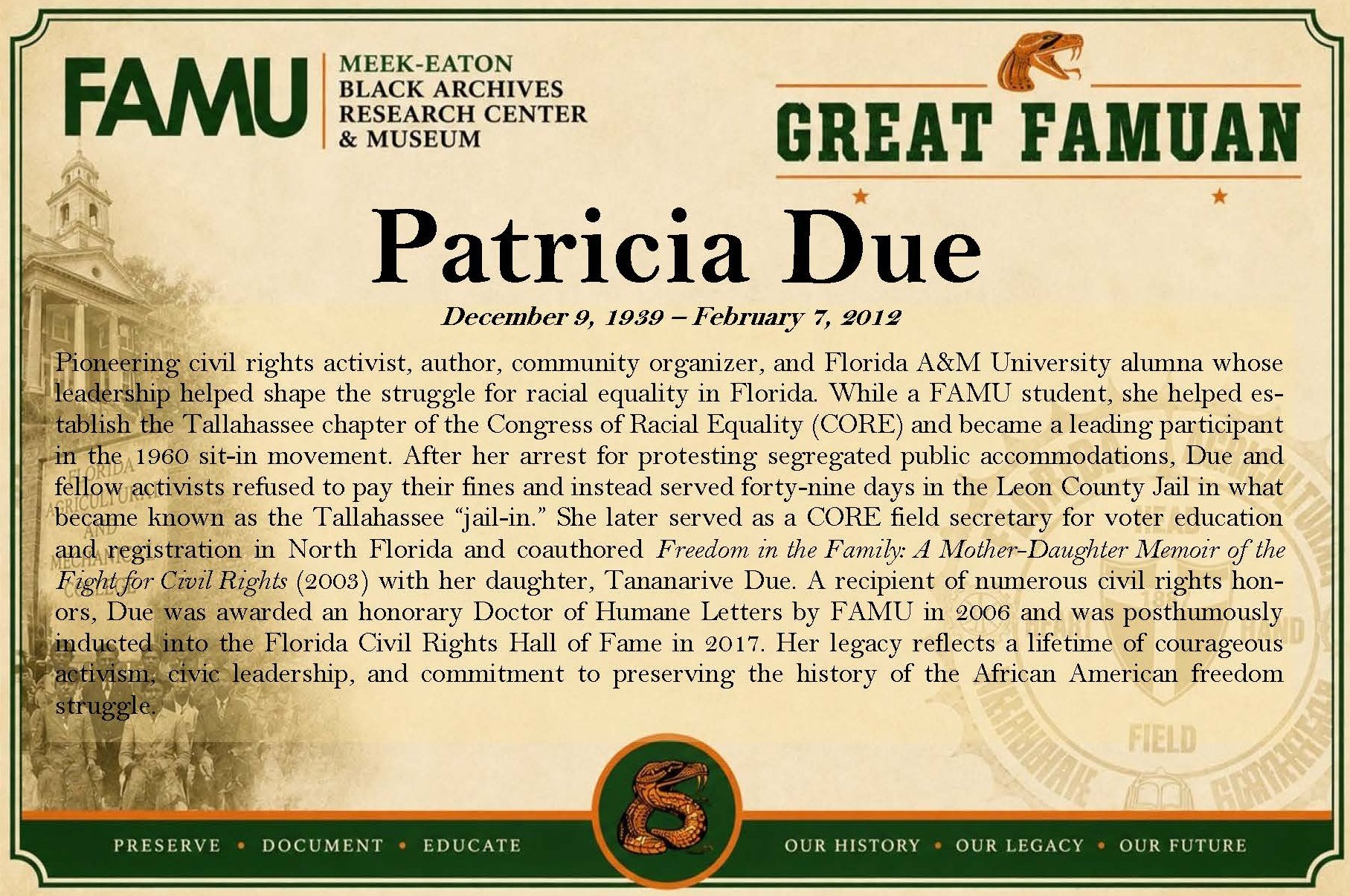
Distinguished place in the history of Florida A&M University as an alumna, student leader, civil rights activist, and enduring symbol of the University's tradition of civic engagement. She entered Florida Agricultural and Mechanical University in 1957, arriving on a campus that had already become deeply connected to Tallahassee's developing Civil Rights Movement. The 1956 Tallahassee Bus Boycott, sparked by the arrests of FAMU students Wilhelmina Jakes and Carrie Patterson, had demonstrated the capacity of university students to challenge racial segregation and mobilize the surrounding African American community. Due would soon become part of the next generation of FAMU students to carry that tradition of activism forward.
Due's education at FAMU unfolded during a transformative period in American history. Although African Americans were pursuing expanded educational and professional opportunities, segregation continued to regulate public accommodations, transportation, housing, employment, and political participation throughout the South. FAMU provided its students with rigorous academic preparation while also functioning as an important center of African American intellectual, cultural, and civic life. For Due, the University became both an institution of higher learning and the setting from which she emerged as one of Florida's significant young civil rights leaders.
In 1959, while a FAMU student, Due and her sister, Priscilla Stephens, attended a Congress of Racial Equality (CORE) workshop in Miami devoted to the principles and strategies of nonviolent direct action. The training introduced participants to methods for confronting racial discrimination through disciplined protest. Upon returning to Tallahassee, the sisters became instrumental in establishing a local chapter of CORE in 1960. The organization provided FAMU students and other activists with a structured means of challenging segregated public accommodations throughout Florida's capital city.
Due subsequently emerged as a leader in the student demonstrations that challenged segregation in downtown Tallahassee. In 1960, she participated in sit-ins at segregated lunch counters, joining other students in asserting their right to equal service. During a demonstration at Woolworth's, Due and eight other students were arrested and charged with unlawful assembly and disturbing the peace. Their arrests became part of a larger confrontation between a younger generation demanding equal citizenship and institutions attempting to preserve the established racial order.
Rather than pay the fines imposed upon them, Due and several fellow activists elected to serve jail sentences. Their decision became known as the Tallahassee “jail-in,” an important episode in the history of nonviolent student protest. By choosing incarceration rather than paying fines, the students rejected the characterization of peaceful civil rights protest as criminal conduct. Due ultimately spent forty-nine days in the Leon County Jail, transforming her imprisonment into an extension of the protest against segregation.
While incarcerated, Due documented her experiences in her *Letter from Leon County Jail*. Her writing provided a firsthand account of the personal sacrifices associated with civil rights activism and articulated the moral conviction underlying the students' refusal to accept racial discrimination. The document remains an important expression of student activism and illustrates the intellectual as well as physical dimensions of the freedom struggle.
Due also suffered lasting physical consequences from her activism. During a civil rights demonstration, she was exposed to tear gas at close range, resulting in a lifelong sensitivity to light. The dark glasses she subsequently wore became one of her most recognizable personal characteristics and served as a visible reminder of the physical costs borne by those who confronted segregation.
Her activism significantly affected the conventional progression of her collegiate education. Organizing demonstrations, enduring arrest and incarceration, and undertaking broader civil rights responsibilities required substantial time and personal sacrifice. Nevertheless, Due remained committed to completing her education. She returned to her studies and earned her Bachelor of Arts degree from Florida A&M University in 1965.
Due's experience illustrates the important relationship between HBCUs and the Civil Rights Movement. FAMU students did not confine their education to classrooms and laboratories; many applied principles of leadership, citizenship, and social responsibility to the inequalities confronting African Americans beyond the University's campus. Due became one of the most consequential examples of this tradition, demonstrating how student leadership could influence the civic and political development of an entire community.
Her relationship with FAMU continued long after graduation. As the University increasingly documented and commemorated its civil rights history, Due became an important interpreter of the student movement and a representative of the generation that had challenged segregation in Tallahassee. She returned to the University community to share her experiences and encourage younger generations to understand the responsibilities associated with citizenship, education, and service.
In recognition of her extraordinary contributions, Florida A&M University awarded Due an honorary Doctor of Humane Letters in 2006. She also received FAMU's Gandhi Award for Outstanding Work in Human Relations, reflecting the University's recognition of her commitment to nonviolence, human dignity, and racial equality.
Due's connection to FAMU has also been preserved through the Meek-Eaton Black Archives Research Center and Museum, which maintains the Dr. Patricia Stephens Due Collection. The preservation of her papers and related materials ensures that her experiences as a student activist, civil rights organizer, and alumna remain available for scholarly research, teaching, exhibitions, and public interpretation.
Patricia Stephens Due's FAMU legacy consequently extends far beyond her status as a graduate. Her student years demonstrate the intersection of education and civic responsibility that has characterized important chapters of Florida A&M's history. She entered the University seeking an education but became part of a generation of Rattlers whose activism challenged the racial order of Florida's capital city and contributed to the broader struggle for equal citizenship.
Her life at FAMU represents a powerful chapter in the University's civil rights heritage. Through disciplined nonviolent protest, personal sacrifice, intellectual conviction, and perseverance in completing her education, Due embodied the capacity of students to transform their communities while pursuing academic advancement. Her legacy remains an enduring testament to FAMU's place within the history of the African American freedom struggle and to the generations of students who understood education as both an opportunity and a responsibility to serve.
-
Life Bio
-
Pioneering civil rights leader, community organizer, author, wife, mother, and advocate whose life was devoted to expanding racial equality and preserving the history of the African American freedom struggle. Born in Quincy, Florida, to Lottie Mae Powell Stephens and Horace Walter Stephens, she was the middle of three children and spent much of her childhood in Quincy before living in Belle Glade and Miami. Growing up under Jim Crow segregation profoundly shaped her understanding of race, citizenship, and social justice.
Due demonstrated an early willingness to confront racial discrimination. At approximately thirteen years old, she and her sister, Priscilla Stephens, challenged segregation by seeking service at a Dairy Queen window designated for white customers in Belle Glade. This youthful act of resistance foreshadowed the disciplined activism that would later define an important period of her life.
As a young woman, Due became deeply involved with the Congress of Racial Equality (CORE), one of the major organizations employing nonviolent direct action to challenge segregation. Following training in the principles and methods of nonviolent civil disobedience, she helped organize demonstrations against segregated public accommodations and became an important grassroots leader within Florida's developing Civil Rights Movement.
Her activism demanded considerable personal sacrifice. Due participated in sit-ins and other demonstrations, endured arrest and incarceration, and suffered lasting physical effects after being exposed to tear gas during a protest. Rather than retreat from activism, these experiences strengthened her commitment to challenging systems that denied African Americans equal treatment and full participation in American society.
Due's leadership expanded beyond demonstrations against segregated public accommodations. In 1964, CORE selected her to serve as field secretary for its North Florida voter education and registration project. This work addressed one of the most fundamental issues confronting African Americans in the Jim Crow South: systematic disfranchisement. Black citizens frequently encountered discriminatory registration practices, intimidation, economic retaliation, and other barriers designed to restrict their political participation.
As a field secretary, Due helped organize voter education and registration initiatives throughout North Florida. The work required extensive grassroots organizing and direct engagement with African American communities. Her responsibilities reflected the evolution of the Civil Rights Movement from challenges to segregation in public accommodations toward a broader effort to secure meaningful political participation and institutional power.
Due's voter-registration work placed her within a longstanding tradition of Black women organizers whose contributions were indispensable to the Civil Rights Movement. Women recruited participants, organized local networks, maintained communication, raised resources, educated voters, and sustained movements between major demonstrations. Due's leadership illustrates the essential organizational work through which civil rights objectives were translated into lasting community participation.
In 1963, Patricia Stephens married civil rights attorney John D. Due Jr., creating a personal and professional partnership grounded in a shared commitment to racial justice. John Due's work as an attorney complemented Patricia's experience as an activist and organizer, and together they remained involved in civil rights advocacy and community affairs.
The couple raised three daughters: Tananarive Due, Johnita Due, and Lydia Due Greisz. Family became an important dimension of Due's understanding of the Civil Rights Movement. Like many activists, she balanced public service and advocacy with the responsibilities of marriage and motherhood. The values that shaped her activism—courage, responsibility, historical consciousness, and commitment to equality—became part of the intellectual and moral inheritance she transmitted to her children.
In later years, Due increasingly devoted attention to preserving the history of the movement and ensuring that younger generations understood the sacrifices made by grassroots activists. She became an important public speaker and historical witness, interpreting the Civil Rights era through the perspective of someone who had experienced its risks and transformations firsthand.
This commitment to historical memory culminated in her collaboration with her daughter, acclaimed author Tananarive Due, on *Freedom in the Family: A Mother-Daughter Memoir of the Fight for Civil Rights*, published in 2003. The memoir interweaves personal and family history with the broader narrative of the Civil Rights Movement, demonstrating how struggles for racial justice shaped families across generations.
The work is especially significant because it situates civil rights activism within the intimate experiences of family life. Rather than treating the movement solely as a sequence of demonstrations, court decisions, and prominent leaders, *Freedom in the Family* examines how activism affected relationships, childhood experiences, personal sacrifices, and the transmission of historical memory from one generation to another.
Due received numerous honors for her contributions to civil and human rights. Among her recognitions were the Eleanor Roosevelt Award for Outstanding Leadership, the Gandhi Award for Outstanding Work in Human Relations, and the NAACP Florida Freedom Award. These honors reflected decades of leadership extending from direct-action protest to voter education, community advocacy, and historical preservation.
In 2011, Tallahassee Mayor John R. Marks issued a proclamation designating May 11 as “Patricia Stephens Due Day,” formally recognizing her contributions to the city's civil rights history. The commemoration acknowledged the profound transformation Tallahassee had undergone since the era when Due and other young activists had faced arrest for challenging segregation.
Patricia Stephens Due died on February 7, 2012, in Smyrna, Georgia, at the age of seventy-two following a battle with thyroid cancer. Her passing marked the loss of an important firsthand witness to and participant in the Civil Rights Movement, but her writings, family, public testimony, archival record, and decades of advocacy ensured that her experiences would continue to inform future generations.
In 2017, Due was posthumously inducted into the Florida Civil Rights Hall of Fame. The honor affirmed her place among the individuals whose leadership and sacrifice contributed substantially to the transformation of civil rights in Florida.
Due's legacy is distinguished by the continuity of her commitment to freedom. She challenged racial discrimination as a child, confronted segregation as a young activist, organized communities for political participation as a civil rights professional, raised a family shaped by commitments to justice and service, and later became an author and historical witness dedicated to preserving the movement's memory.
Patricia Stephens Due therefore represents far more than a single episode of Civil Rights-era protest. Her life demonstrates the interconnected nature of direct action, voter education, family, community organization, and historical preservation. She belonged to a generation of African American women whose courage and organizational leadership were indispensable to the freedom struggle, even when their contributions were not always accorded equivalent prominence in traditional historical narratives.
Her enduring legacy resides both in the barriers she helped dismantle and in the historical memory she worked to preserve. Through activism, organization, family, authorship, and public education, Patricia Stephens Due transformed personal resistance into a lifetime of service. Her story remains an important testament to the power of grassroots leadership and to the indispensable role of Black women in the long struggle for civil rights and equal citizenship in the United States.
-
Artifact Dimensions
-
L x W: 16.25 x 20.25in (41.28 x 51.44cm)
-
Medium
-
Printed Photo, gold painted frame
-
Rights
-
All rights reserved. The use of any part of these objects and photographs transmitted in any form by any means, electronic, mechanical, photocopying, recording, or otherwise, or stored in a retrieval system without the prior written consent of Meek-Eaton Black Archives is an infringement of the copyright law.
-
Rights Holder
-
Meek - Eaton Southeastern Regional Black Archives Research Center and Museum