-
Title
-
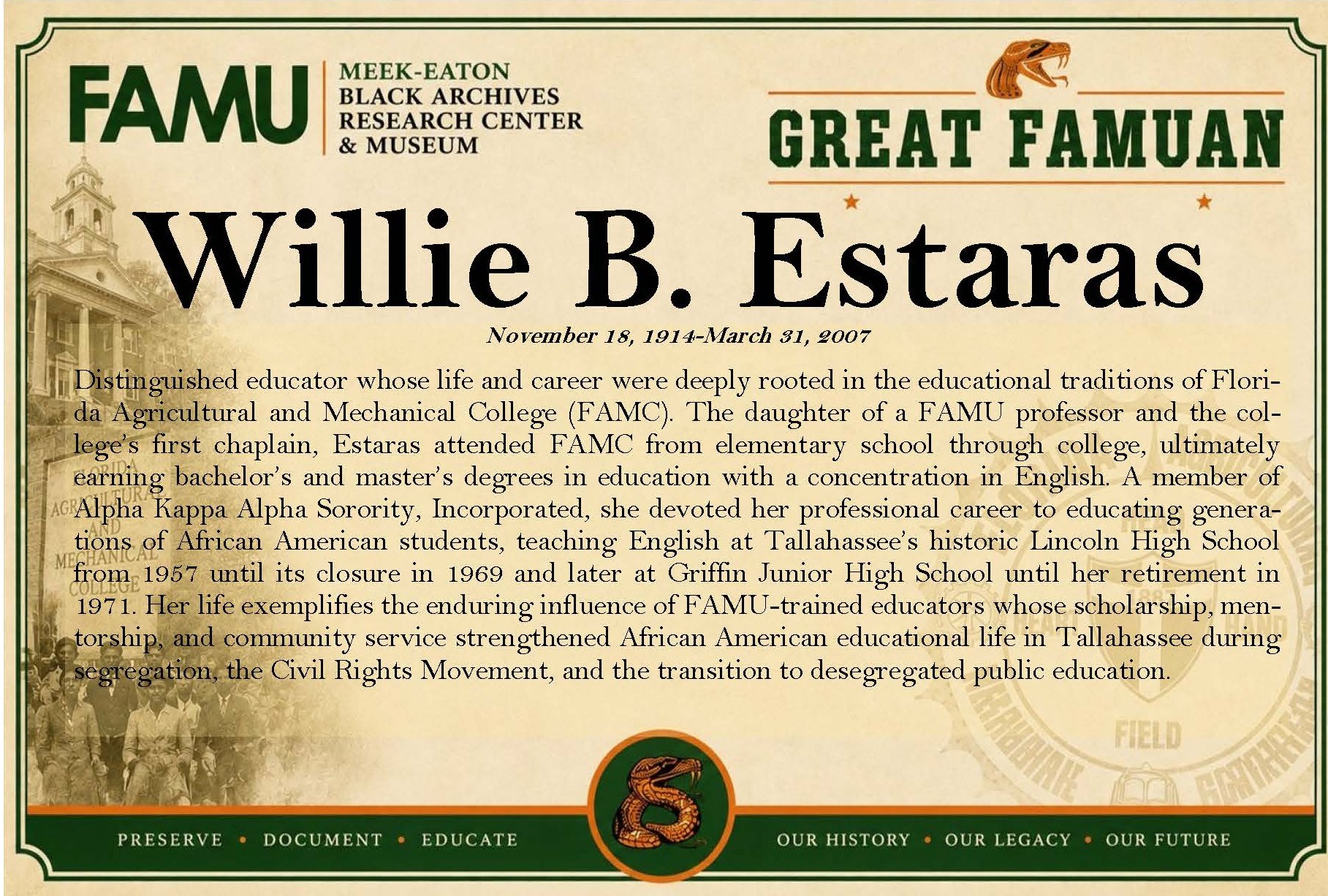
Willie B. Estaras
-
Alternative Title
-
Willie B. “Sweetpea” Estaras
-
Birth Date
-
November 18, 1914
-
Transition Date
-
March 31, 2007
-
Category
-
Education
-
Affiliation to FAMU
-
Professor
-
Life at FAMU
-
Born into a family closely associated with the institution, Estaras was the daughter of a FAMU professor who also served as the college’s first chaplain. From childhood through adulthood, the campus served as an important intellectual, educational, and cultural foundation in her life.
Estaras’s relationship with FAMC began long before her collegiate studies. She received her education within the FAMC community from elementary school through college, reflecting the historically broad educational mission of the institution. During an era when segregation severely restricted educational opportunities for African Americans, institutions such as FAMC provided educational pathways extending beyond traditional collegiate instruction. For Estaras, this environment offered a remarkable continuity of education and placed her within a community in which Black scholarship, professional achievement, leadership, and cultural life were cultivated and celebrated.
She subsequently earned both bachelor’s and master’s degrees in education from FAMC, with an academic concentration in English. Her preparation reflected one of the institution’s most significant historical responsibilities: the education and professional development of African American teachers. FAMC graduates carried their training into schools and communities throughout Florida and beyond, becoming educators, administrators, civic leaders, and advocates whose influence extended the university’s mission far beyond its campus.
Estaras exemplified this tradition. The education she received at FAMC became the foundation for a career devoted to teaching English and developing young minds. Her professional service demonstrates the broader influence of Florida A&M upon African American education in Tallahassee: the institution did not simply confer degrees but helped prepare generations of educators who became pillars of the communities they served.
Her story consequently represents more than that of an alumna. Estaras belonged to a multigenerational FAMU tradition extending from her father’s service as a professor and the institution’s first chaplain to her own education and subsequent career as a teacher. Her life illustrates how Florida A&M functioned as both an educational institution and a community—one capable of shaping families across generations and producing graduates committed to scholarship, leadership, and service.
Through Willie B. “Sweetpea” Estaras, the history of FAMU can be understood on a deeply personal scale. Her journey from elementary student to graduate-trained educator embodies the institution’s enduring commitment to educational advancement and demonstrates how the FAMU experience extended outward through the lives and service of its graduates. Her legacy stands as part of a larger tradition in which the university prepared individuals not simply to achieve professionally, but to carry forward a responsibility to educate, strengthen, and serve their communities.
-
Life Bio
-
Respected educator and community figure whose career reflected a lifelong commitment to education, intellectual development, and service. As an English teacher, she belonged to a generation of African American educators whose work profoundly shaped Black educational life during segregation and the transformative years of the Civil Rights Movement.
Estaras devoted much of her professional career to Tallahassee’s original Lincoln High School, where she began teaching English in 1957. Established to educate African American students during segregation, Lincoln became an important center of academic achievement, cultural identity, and community life. Within this environment, educators such as Estaras served not only as classroom instructors but also as mentors and models of professional accomplishment. Through the study of English and literature, she contributed to the development of generations of students during a period when African American teachers and schools frequently worked against significant disparities in educational resources and opportunities.
Her years at Lincoln coincided with a consequential period in Tallahassee and the nation. The Civil Rights Movement challenged the legal and social structures of segregation, while federal court decisions and subsequent desegregation efforts fundamentally transformed public education. Estaras remained at Lincoln until its closure in 1969, placing her professional experience at the intersection of two distinct eras in Southern education. Following the school’s closure, she continued her career at Griffin Junior High School, where she taught until her retirement in 1971.
Estaras’s commitment to service also extended beyond the classroom. On November 22, 1941, she was initiated into the Gamma Theta Omega Chapter of Alpha Kappa Alpha Sorority, Incorporated. Her affiliation placed her within a longstanding tradition of college-educated African American women who used education, professional leadership, civic engagement, and organized service to strengthen their communities.
The life of Willie B. “Sweetpea” Estaras reflects the often understated but essential contributions of African American educators to the social and intellectual development of their communities. Her legacy is preserved not simply through the institutions in which she worked, but through the students she instructed, the organizations she supported, and the educational traditions she helped sustain. Her career provides an important window into the history of Black education in Tallahassee and the generations of teachers who guided their students through segregation, civil rights activism, and the transition toward desegregated public education.
-
Artifact Dimensions
-
L x W: 17.38 x 14.25in (44.13 x 36.2cm)
-
Rights
-
All rights reserved. The use of any part of these objects and photographs transmitted in any form by any means, electronic, mechanical, photocopying, recording, or otherwise, or stored in a retrieval system without the prior written consent of Meek-Eaton Black Archives is an infringement of the copyright law.
-
Rights Holder
-
Meek - Eaton Southeastern Regional Black Archives Research Center and Museum