-
Title
-
Leander J. Shaw, Jr.
-
Alternative Title
-
Honorable Leander Shaw, Jr.
-
Birth Date
-
September 6, 1930
-
Transition Date
-
December 14, 2015
-
Category
-
Law
-
Affiliation to FAMU
-
College of Law
-
Life at FAMU
-
From 1957 to 1960, Shaw taught at the original Florida A&M University College of Law, contributing to an institution established to provide legal education to African Americans during segregation. His service placed him among the faculty members responsible for preparing aspiring Black attorneys at a time when access to the legal profession remained constrained by racial discrimination and institutional exclusion.
The original FAMU College of Law occupied a particularly important position within Florida’s educational and legal history. Within this environment, Shaw brought his Howard University legal education into the classroom, helping prepare students for careers in law, public service, and civic leadership. His role as a law professor reflected FAMU’s broader mission of creating pathways into professions in which African Americans had historically been underrepresented.
Shaw returned to significant university leadership when he served as Dean of the Graduate School from 1964 to 1968. In this capacity, his responsibilities expanded beyond legal education to the broader academic mission of the university. His tenure occurred during the Civil Rights era, when historically Black colleges and universities were confronting changing social conditions, expanding graduate education, and navigating the transformation of higher education brought about by desegregation.
As dean, Shaw belonged to a generation of FAMU academic leaders charged with sustaining rigorous educational standards while expanding opportunities for advanced study. His leadership contributed to the university’s continuing development as an institution committed not only to undergraduate education but also to graduate scholarship, professional preparation, and the cultivation of future educators, scholars, and public servants.
Shaw’s years at Florida A&M also provide important context for his later achievements in the judiciary. His experience as a legal educator and academic administrator preceded a distinguished career that eventually carried him to the Florida Supreme Court and its chief justiceship. In this respect, his FAMU service represents a formative chapter within a larger life devoted to law, education, and public service.
Leander J. Shaw Jr.’s legacy at Florida A&M therefore extends across both legal and graduate education. As a professor at the original College of Law and later Dean of the Graduate School, he contributed to FAMU’s historic mission of expanding educational and professional opportunities for African Americans. His subsequent achievements as a Florida Supreme Court justice and chief justice further distinguished a career whose foundations were closely connected to scholarship and education. His story remains an important part of FAMU’s broader tradition of preparing and cultivating individuals whose leadership has shaped Florida and the nation.
-
Life Bio
-
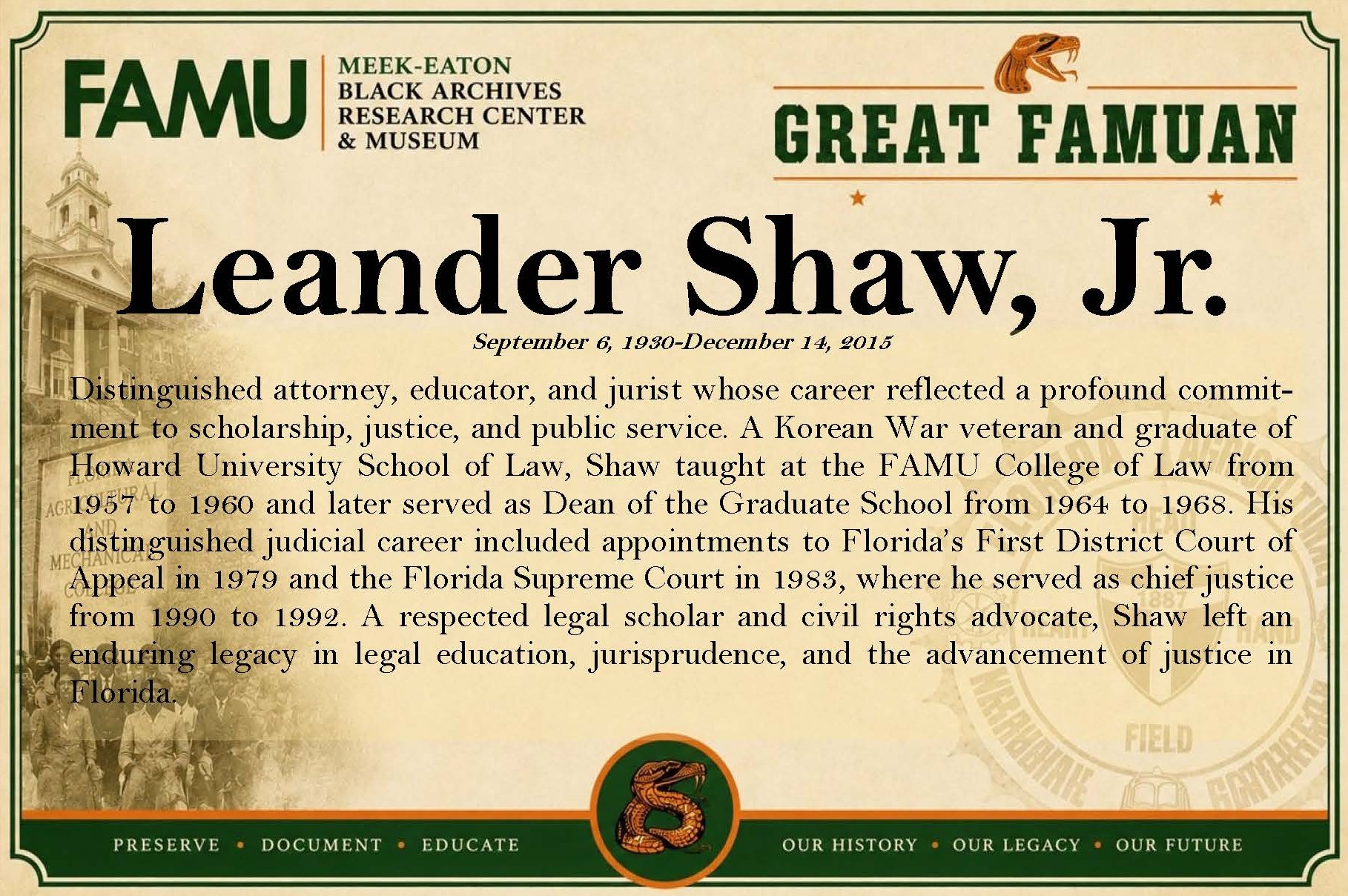
Distinguished attorney, legal scholar, educator, and jurist whose career represented a sustained commitment to justice, public service, and the advancement of the legal profession. Born in Salem, Virginia, Shaw came of age during an era when racial segregation profoundly shaped educational, professional, and civic opportunities for African Americans. His eventual rise to the highest court in Florida reflected both exceptional professional achievement and the expanding presence of African American attorneys and jurists within institutions from which they had historically been excluded.
Before entering the legal profession, Shaw served his country as an artillery officer during the Korean War. Following his military service, he pursued legal education at Howard University School of Law, an institution with a distinguished history of preparing African American attorneys and civil rights advocates. His legal training placed him within an intellectual tradition that understood the law not merely as a profession but as an important instrument for protecting constitutional rights, addressing inequality, and advancing social change.
Shaw developed a multifaceted career encompassing legal practice, scholarship, teaching, and public service. His professional trajectory ultimately led to the Florida judiciary. In 1979, he was appointed to Florida’s First District Court of Appeal, marking an important stage in a judicial career that would eventually place him among the state's most influential jurists. In 1983, Shaw was appointed to the Florida Supreme Court, where he participated in the interpretation and application of Florida law at its highest judicial level.
His fellow justices selected him to serve as chief justice of the Florida Supreme Court from 1990 to 1992. His elevation to this leadership position represented a significant achievement within the history of Florida’s judiciary, particularly within the broader context of the long struggle for African American representation in the legal profession and public institutions. Throughout his judicial career, Shaw became known for his legal scholarship, commitment to fairness, and engagement with questions of justice and civil rights.
Shaw’s contributions earned substantial professional and civic recognition. Among his honors were his designation as Florida Humanist of the Year in 1991 and receipt of the Ben Franklin Award in 1992. Such recognition reflected the breadth of a career that extended beyond judicial office to encompass education, intellectual engagement, public leadership, and service.
Justice Leander J. Shaw Jr.’s life represents an important chapter in the history of African American participation in the legal profession and Florida’s judiciary. From military officer and law student to educator, attorney, appellate judge, and chief justice, his career demonstrated the transformative possibilities of education, disciplined scholarship, and public service. His legacy endures through his contributions to jurisprudence, legal education, civil rights, and the administration of justice in Florida.
-
Artifact Dimensions
-
L x W: 20.13 x 17.13in (51.12 x 43.5cm)
-
Medium
-
Photograph
-
Rights
-
All rights reserved. The use of any part of these objects and photographs transmitted in any form by any means, electronic, mechanical, photocopying, recording, or otherwise, or stored in a retrieval system without the prior written consent of Meek-Eaton Black Archives is an infringement of the copyright law.
-
Rights Holder
-
Meek - Eaton Southeastern Regional Black Archives Research Center and Museum