-
Title
-
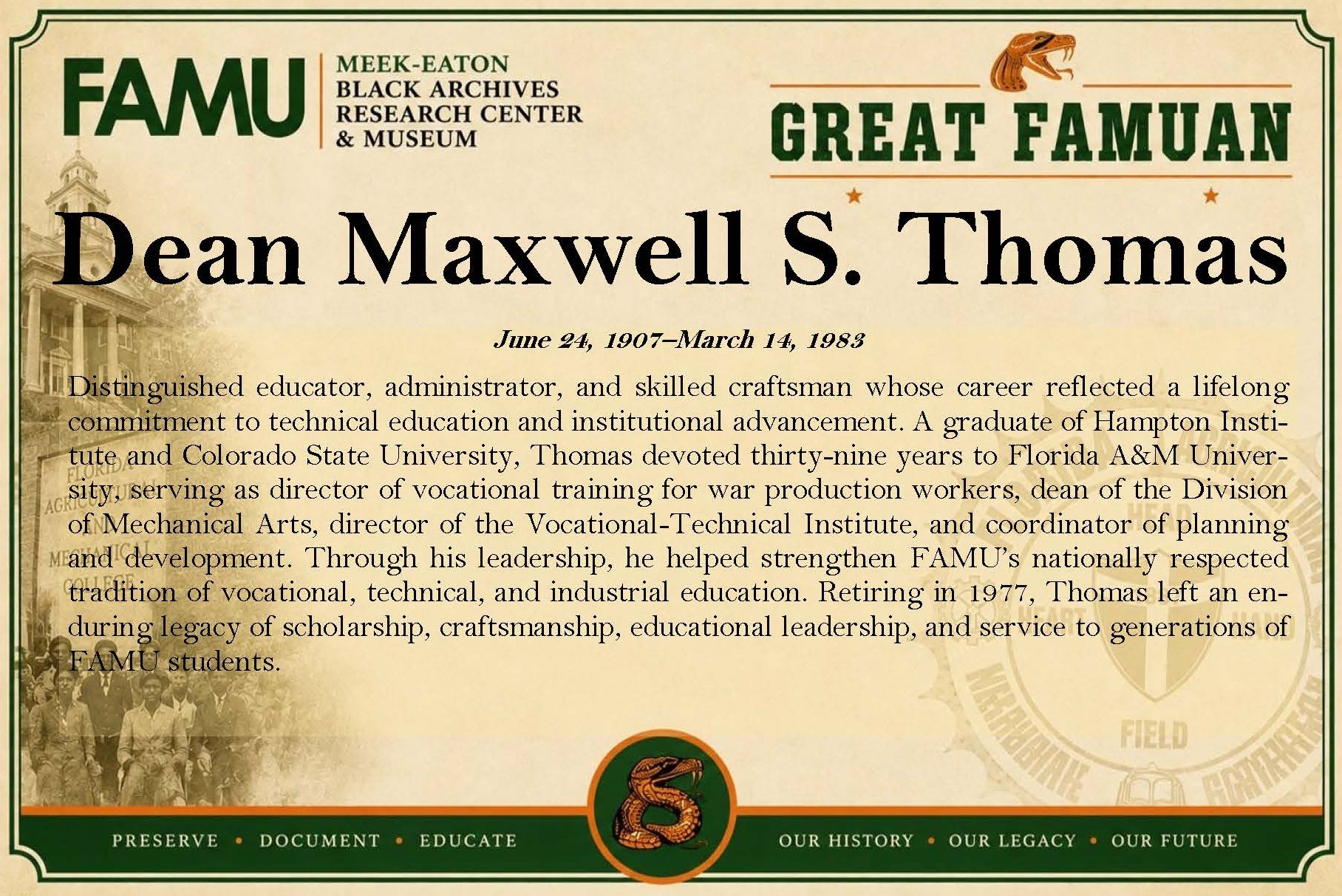
Dean Maxwell S. Thomas
-
Alternative Title
-
M. S. Thomas
-
Birth Date
-
June 24, 1907
-
Transition Date
-
March 14, 1983
-
Category
-
Education
-
Affiliation to FAMU
-
Dean of Mechanical Arts
-
Life at FAMU
-
Devoted thirty-nine years of his professional life to Florida A&M University, where his leadership contributed significantly to the development of vocational, technical, and industrial education. His career at the institution spanned several transformative decades, during which Florida A&M evolved academically and institutionally while responding to changing national demands in education, industry, workforce development, and technology.
During World War II, Thomas served as director of vocational training for war production workers, placing him and Florida A&M within the national effort to prepare skilled personnel for wartime industries. His work was particularly significant within the context of segregation, when historically Black colleges provided essential educational and technical training opportunities for African Americans who frequently encountered exclusion from other institutions and occupational fields.
Thomas later served as dean of the Division of Mechanical Arts, where he played an important role in strengthening FAMU’s vocational and industrial curriculum. His leadership emphasized rigorous preparation, technical competence, and the professionalization of skilled trades. Through these programs, students acquired knowledge that prepared them not only for technical employment but also for careers as vocational educators, administrators, and leaders within their respective fields.
His institutional responsibilities subsequently expanded when he became director of the Vocational-Technical Institute. In this role, Thomas helped develop and strengthen a program that became recognized for excellence in vocational, technical, and industrial education. His leadership contributed to FAMU’s ability to prepare generations of students for a changing workforce while reinforcing the university’s historic commitment to educational access and economic advancement.
Thomas later served as coordinator of planning and development, extending his influence into broader institutional administration. This appointment demonstrated the range of his expertise and reflected the confidence placed in his ability to contribute to FAMU’s long-term growth. His progression through multiple leadership positions illustrates a career devoted not simply to a single academic discipline but to the larger development and mission of the university.
Throughout his thirty-nine years at FAMU, Thomas combined the perspectives of educator, administrator, and craftsman. His belief in the intellectual value and dignity of skilled work helped strengthen an educational tradition in which technical expertise was understood as an essential component of professional and institutional excellence.
Thomas retired from Florida A&M University in 1977, concluding nearly four decades of service. His contributions helped establish and sustain one of the institution’s respected traditions in vocational, technical, and industrial education. Through his leadership, generations of students were prepared to carry their knowledge and skills into classrooms, industries, businesses, and communities. His legacy remains an important part of FAMU’s history of connecting academic achievement, practical knowledge, professional preparation, and service.
-
Life Bio
-
Distinguished educator, administrator, skilled craftsman, and community servant whose life reflected a sustained commitment to education, technical knowledge, and professional excellence. Born in Ocala, Florida, Thomas came of age during an era when segregation significantly restricted educational and occupational opportunities for African Americans. His career would ultimately demonstrate the important role that education and skilled craftsmanship could play in expanding professional opportunities and strengthening communities.
Thomas pursued higher education at Hampton Institute, now Hampton University, an institution nationally recognized for its historic contributions to African American education and professional preparation. He earned his bachelor’s degree in 1932, receiving an education that combined academic study with traditions of industrial and technical training. This foundation helped shape his professional philosophy and his lifelong appreciation for the relationship between intellectual development, practical knowledge, and skilled labor.
Committed to continued professional development, Thomas later pursued graduate study at Colorado State University, where he earned a master’s degree in 1947. His advanced education strengthened his preparation as an educator and administrator and positioned him to contribute to the development of vocational, technical, and industrial education during a period when these fields were becoming increasingly important to the American economy.
Thomas was also remembered as an accomplished carpenter, an identity that complemented his work as an educator. His craftsmanship represented more than a practical skill; it reflected values of precision, discipline, creativity, patience, and mastery. Throughout his professional life, he affirmed the dignity of skilled labor and demonstrated that technical expertise and academic achievement were complementary rather than competing forms of knowledge.
His career unfolded during profound transformations in American education and industry, including World War II, postwar economic expansion, the Civil Rights Movement, desegregation, and rapid technological change. Within this evolving landscape, Thomas dedicated his professional life to preparing others with knowledge and skills that could lead to employment, economic advancement, and meaningful service.
Remembered as a dedicated teacher, craftsman, administrator, and community servant, Maxwell Samuel Thomas embodied an educational philosophy that united scholarship with practical application. His life demonstrated the enduring importance of vocational and technical education in creating pathways toward professional independence and community development, particularly for African Americans confronting the social and economic barriers of the twentieth century.
-
Artifact Dimensions
-
L x W: 26.75 x 22.75in (67.95 x 57.79cm)
-
Medium
-
Photograph with light wood frame
-
Rights
-
All rights reserved. The use of any part of these objects and photographs transmitted in any form by any means, electronic, mechanical, photocopying, recording, or otherwise, or stored in a retrieval system without the prior written consent of Meek-Eaton Black Archives is an infringement of the copyright law.
-
Rights Holder
-
Meek - Eaton Southeastern Regional Black Archives Research Center and Museum