-
Title
-
Irene C. Edmonds
-
Alternative Title
-
Irene C. Edmonds with daughter "Henri"
-
Birth Date
-
1908
-
Transition Date
-
1968
-
Category
-
Education
-
Affiliation to FAMU
-
Theater
-
Life at FAMU
-
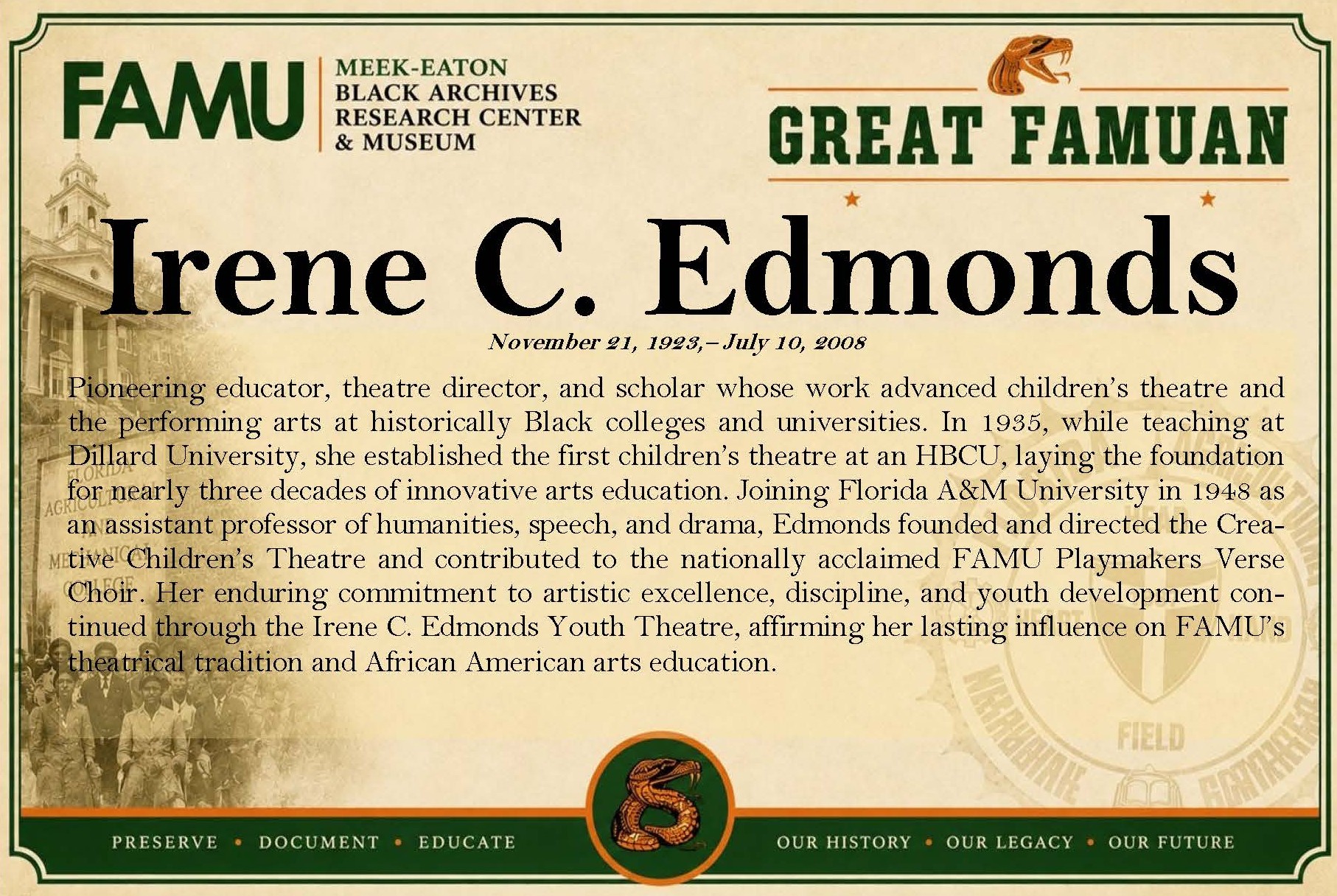
Began her influential association with Florida A&M University in 1948, joining the faculty as an assistant professor of humanities, speech, and drama. During twenty years of service, until her death in 1968, Edmonds contributed significantly to the development of FAMU’s theatrical and performing arts traditions while establishing a model of university-based theatre education that extended beyond the campus and into the surrounding community.
In 1948, Edmonds founded the Creative Children’s Theatre at FAMU, building upon her previous pioneering work in educational children’s theatre. She directed the program until 1960, developing it into an important component of the university’s cultural and theatrical life. Through the Creative Children’s Theatre, Edmonds provided young people with structured opportunities to experience acting, dramatic interpretation, speech, literature, and collaborative performance within the intellectual environment of a historically Black university.
Her work reflected a broader understanding of FAMU’s educational mission. Theatre, in Edmonds’s approach, was not simply entertainment; it was a disciplined educational practice capable of developing communication, creativity, confidence, responsibility, and intellectual curiosity. By connecting university resources with youth arts education, she helped strengthen the relationship between FAMU and the community while cultivating future generations of performers and supporters of the arts.
Edmonds also contributed to the university’s national artistic reputation through her work with the FAMU Playmakers Verse Choir. Combining literature, speech, dramatic interpretation, vocal expression, and ensemble performance, the Verse Choir received national acclaim and demonstrated the breadth of theatrical and literary activity being cultivated at FAMU. Edmonds’s work with the ensemble further established her as an influential figure in the university’s performing arts history.
Her influence continued long after her death through the Irene C. Edmonds Youth Theatre. Reinstated in her honor through FAMU’s College of Social Sciences, Arts and Humanities under Dean Valencia Matthews, Ph.D., the five-week youth program operated from 1997 to 2026. The program preserved principles central to Edmonds’s educational philosophy, including professionalism, decorum, discipline, responsibility, collaboration, commitment, tradition, and respect for the art of theatre.
Irene C. Edmonds’s FAMU legacy thus spans generations. Through the Creative Children’s Theatre, the FAMU Playmakers Verse Choir, her university teaching, and the later youth theatre bearing her name, she helped establish a tradition in which theatrical excellence and youth education were inseparable. Her contributions remain an important chapter in the history of the performing arts at Florida A&M University and affirm her place among the institution’s pioneering arts educators.
-
Life Bio
-
Pioneering educator, theatre director, and advocate for children’s arts education whose career contributed significantly to the development of African American educational theatre during the twentieth century. For twenty-eight years, she devoted her professional work to children’s theatre, approaching dramatic performance as both an artistic discipline and a means of cultivating creativity, confidence, communication, and intellectual development among young people.
Edmonds emerged as an innovator while teaching at Dillard University in New Orleans. In 1935, she established what is recognized as the first children’s theatre at a historically Black college or university. Her achievement was particularly significant during segregation, when African American children and artists encountered limited access to many mainstream cultural and theatrical institutions. By creating structured opportunities for young performers, Edmonds expanded the role of theatre within Black educational life and demonstrated its value as an instrument of artistic and personal development.
Her philosophy of theatre emphasized qualities extending well beyond performance, including discipline, professionalism, responsibility, collaboration, commitment, and respect for artistic practice. Through her work, Edmonds belonged to a generation of African American educators who used the arts to provide young people with opportunities for creative expression while strengthening cultural institutions within their communities.
Her artistic and educational legacy also continued through her daughter, Henrietta “Henri” Edmonds (1935–2009). Henri graduated from Fisk University in 1955 and earned a master’s degree from Western Reserve University in 1956. She later received a Certificate of Clinical Competence from the American Speech and Hearing Association in 1978. Her multifaceted career encompassed music, theatre, education, speech, and film.
Among Henri Edmonds’s notable accomplishments was her musical score for Kelsey E. Collie’s *Brother, Brother, Brother Mine*, which received recognition at the Dundalk International Maytime Festival in 1979. She later portrayed Mary Thomas in the 2004 Emmy Award-winning HBO film *Something the Lord Made*. Her achievements were recognized by educational, civic, sororal, and theatrical organizations, including Howard University, Prince George’s County Public Schools, Delta Sigma Theta Sorority, Incorporated, and members of the theatre community.
Together, Irene and Henrietta Edmonds represent a significant intergenerational legacy in African American arts and education. Their respective careers demonstrate the ways artistic expression, scholarship, mentorship, and education could intersect to create opportunities for performers and audiences across generations.
-
Artifact Dimensions
-
L x W: 45.5 x 35.5in (115.58 x 90.18cm)
-
Medium
-
Oil on Canvas with Wood Frame
-
Provenance
-
Dr. Valencia Matthews
-
Rights
-
All rights reserved. The use of any part of these objects and photographs transmitted in any form by any means, electronic, mechanical, photocopying, recording, or otherwise, or stored in a retrieval system without the prior written consent of Meek-Eaton Black Archives is an infringement of the copyright law.
-
Rights Holder
-
Meek - Eaton Southeastern Regional Black Archives Research Center and Museum