Co-Captains DeVault and Ingram
Item
-
Title
-
Co-Captains DeVault and Ingram
-
Alternative Title
-
Clarence DeVault and Chris Ingram
-
Category
-
Athletics
-
Affiliation to FAMU
-
Football
-
Life at FAMU
-
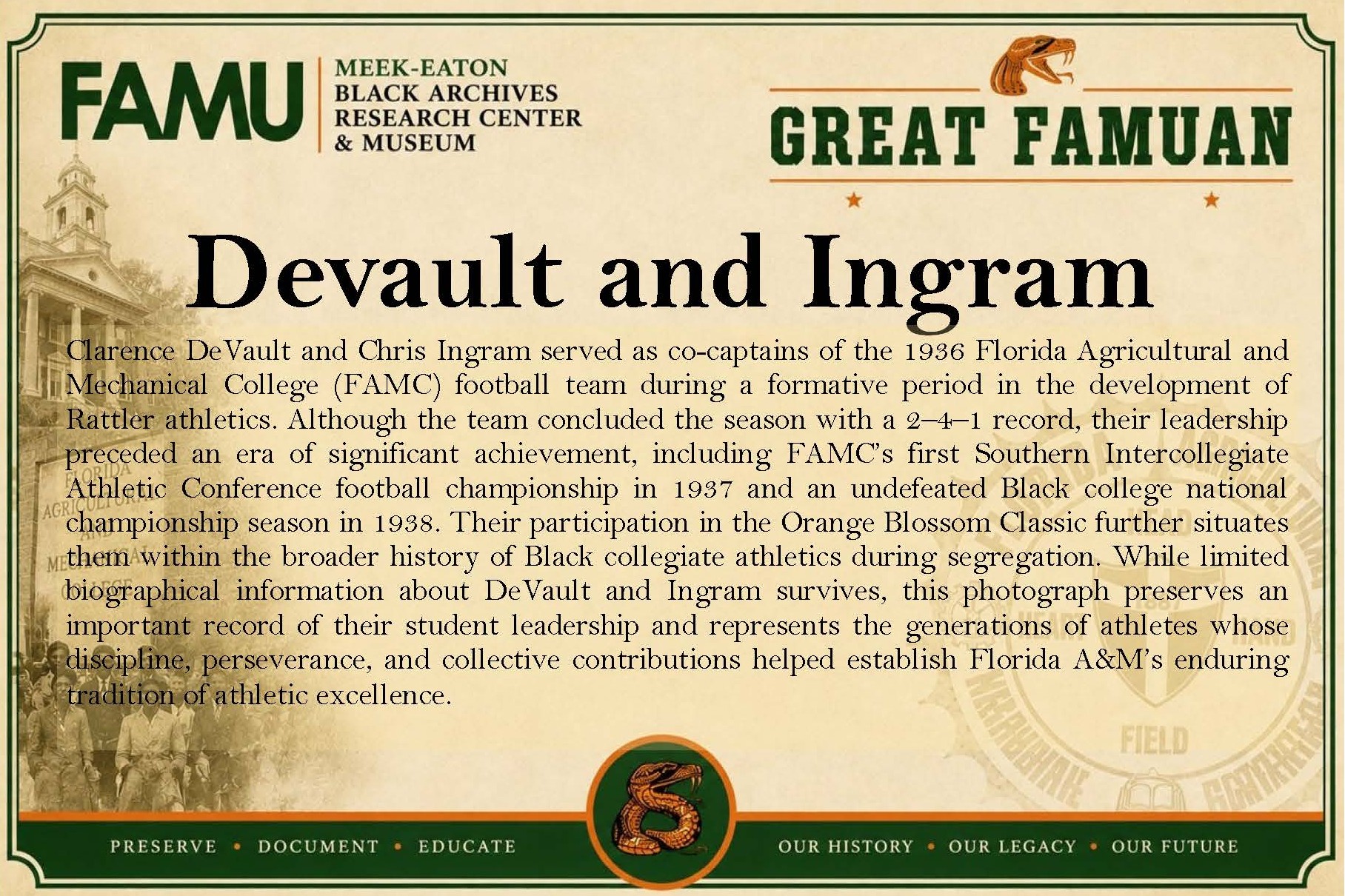
Clarence DeVault and Chris Ingram served as co-captains of the 1936 Florida Agricultural and Mechanical College (FAMC) football team during a formative period in the development of the institution’s athletic tradition. As team captains, DeVault and Ingram occupied positions of distinction and responsibility within the Rattler football program, representing the discipline, perseverance, leadership, and collective commitment expected of student-athletes during an era when intercollegiate athletics provided an important source of institutional pride and visibility for historically Black colleges and universities.
The 1936 season occupies an important place within the broader development of FAMC football. The Rattlers concluded the season with a 2–4–1 record and competed against Prairie View A&M in the Orange Blossom Classic. Although the team’s record did not yet reflect the championship success that would soon define the program, the season represented part of a critical period of development. The following year, FAMC captured its first Southern Intercollegiate Athletic Conference (SIAC) football championship, and in 1938 the Rattlers completed an undefeated season and earned recognition as Black college national champions. Viewed within this progression, the 1936 team represents an important transitional generation whose experiences and contributions preceded FAMC’s emergence as a significant force in Black college football.
DeVault and Ingram were therefore part of a developing athletic culture that helped establish the foundation for future generations of Rattler excellence. Their selection as co-captains suggests the confidence placed in them by the football program to provide leadership both on and beyond the field. During the 1930s, when segregation restricted athletic competition and opportunities for Black collegiate athletes, football programs at HBCUs became important spaces for achievement, community identity, institutional representation, and the cultivation of leadership. Student-athletes such as DeVault and Ingram participated in building traditions that extended beyond individual games and seasons, contributing to the reputation and collective identity of their institutions.
Their participation in the Orange Blossom Classic further situates them within an important chapter of African American athletic history. Established by FAMC, the Classic developed into one of the most prominent events in Black college football, providing HBCU athletes with an important competitive stage during an era when racial segregation largely excluded them from many predominantly white collegiate athletic institutions and major sporting venues. For FAMC, participation in the Classic also provided an opportunity to showcase the university, its students, and its athletic program to audiences beyond Tallahassee.
Although the historical record presently provides limited biographical information about Clarence DeVault and Chris Ingram beyond their association with FAMC football, their presence in this photograph offers an important form of documentary evidence. Archival photographs often preserve individuals whose stories may be only partially represented in written records. In this context, the image does more than identify two football players; it preserves evidence of student leadership, athletic participation, and institutional life at FAMC during the 1930s.
Viewed through the lens of the Meek-Eaton collection, the photograph also encourages consideration of how institutional history is constructed and preserved. Championship seasons and celebrated coaches often dominate narratives of athletic achievement, yet those histories are built upon generations of student-athletes whose individual contributions may be less extensively documented. DeVault and Ingram represent such a generation. Their leadership of the 1936 Rattlers places them immediately before a defining period of championship achievement and connects their story to the larger evolution of Florida A&M athletics.
Preserving and interpreting their photograph therefore restores visibility to individuals who participated in creating the foundation upon which later Rattler traditions were built. As co-captains, Clarence DeVault and Chris Ingram stand as representatives of the many FAMC student-athletes whose discipline, leadership, and commitment strengthened the institution during the early twentieth century. Their image serves as both an athletic record and an artifact of institutional memory, reminding contemporary audiences that Florida A&M University’s celebrated tradition of athletic excellence emerged through the collective contributions of generations who wore the Orange and Green.
-
Artifact Dimensions
-
L x W: 20.25 x 16.25in (51.44 x 41.28cm)
-
Medium
-
Photograph
-
Rights
-
All rights reserved. The use of any part of these objects and photographs transmitted in any form by any means, electronic, mechanical, photocopying, recording, or otherwise, or stored in a retrieval system without the prior written consent of Meek-Eaton Black Archives is an infringement of the copyright law.
-
Rights Holder
-
Meek - Eaton Southeastern Regional Black Archives Research Center and Museum