-
Title
-
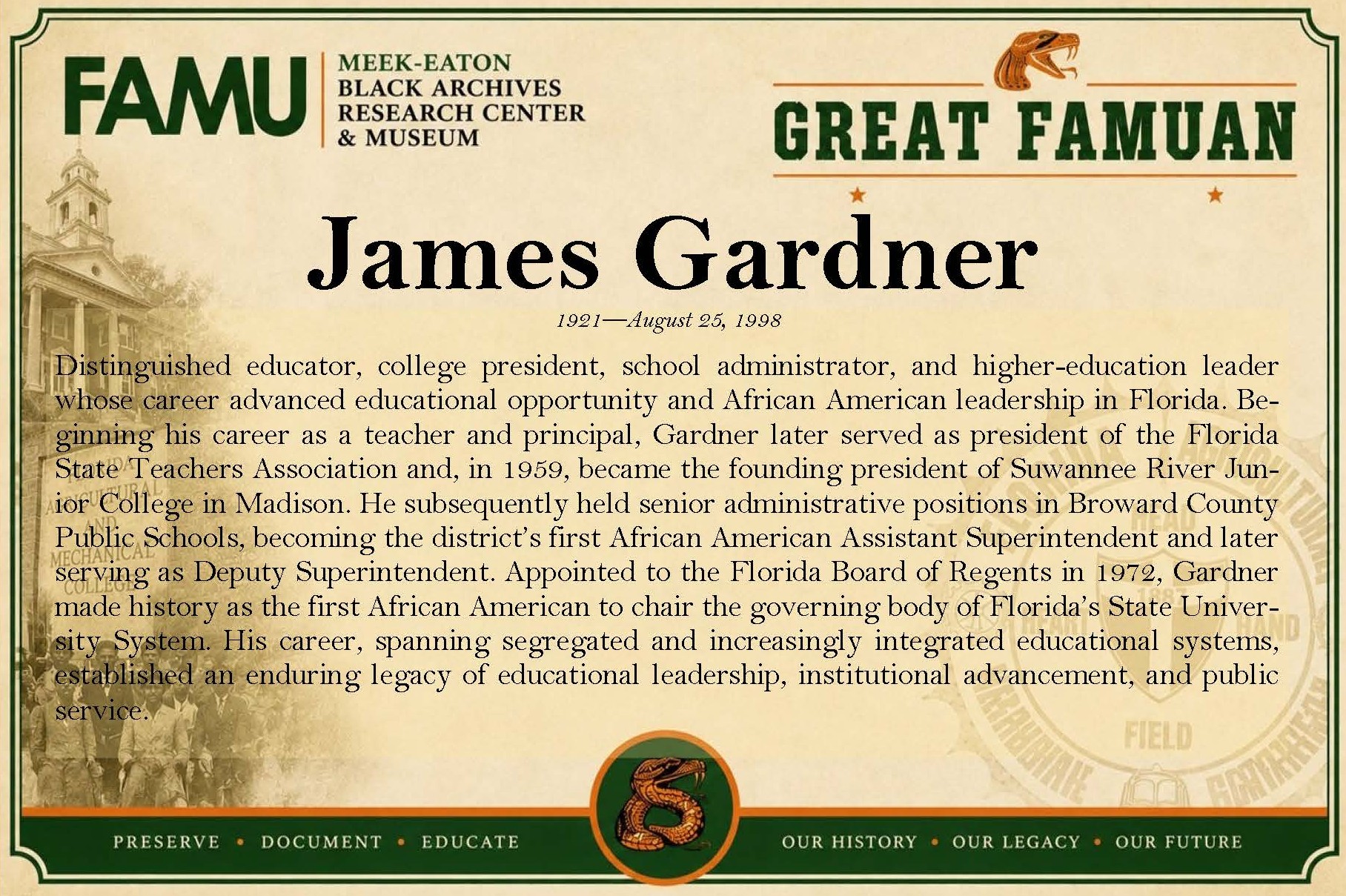
James Gardner
-
Birth Date
-
1921
-
Transition Date
-
August 25, 1998
-
Category
-
Education
-
Affiliation to FAMU
-
Alumnus
-
Life at FAMU
-
He attended Florida Agricultural and Mechanical College, earning a bachelor’s degree in social sciences and elementary education in 1942. He later returned to FAMU for graduate study, earning a master’s degree in school administration and supervision. His education at FAMU provided the foundation for a career that progressed from classroom teaching and school administration to a college presidency and statewide leadership in higher education.
Gardner’s years at Florida A&M occurred during an era when historically Black colleges and universities provided essential pathways to professional education for African Americans excluded from many predominantly white institutions by segregation. FAMU’s longstanding emphasis on teacher preparation was particularly important to Florida’s Black communities, producing generations of educators and administrators who served schools throughout the state. Gardner emerged from this tradition and transformed his FAMU education into a career devoted to educational leadership.
His connection to the University continued through his service as the founding president of Suwannee River Junior College in Madison, Florida, in 1959. Established to serve African American students during segregation, the college provided an important postsecondary pathway for students from several North Florida counties. Its curriculum was designed in significant part to prepare students for transfer to Florida A&M University, further connecting Gardner’s administrative leadership with the educational mission of his alma mater.
Gardner’s career eventually brought him to statewide higher-education leadership. In 1972, Governor Reubin Askew appointed him to the Florida Board of Regents, which governed Florida’s State University System. During his nine years of service, Gardner became the first African American to serve as chairman of the Board. His rise to this position was particularly significant for a FAMU graduate who had received his own education within Florida’s segregated educational system and subsequently became a leader in the governance of public higher education across the state.
Florida A&M continued to recognize Gardner as an exemplary alumnus. In 1994, the FAMU National Alumni Association honored him with its Distinguished Alumni Award for Education, acknowledging a career that reflected the University’s historic traditions of educational leadership and public service.
Gardner’s relationship with FAMU thus extended far beyond the degrees he earned. The University prepared him for educational leadership; he subsequently created pathways through which other African American students could pursue higher education at FAMU; and his later statewide service placed a FAMU alumnus at the highest levels of Florida’s public university governance. His life represents an enduring example of the University’s influence on generations of educators who transformed educational opportunity into institutional leadership and service.
-
Life Bio
-
Born in Georgetown, South Carolina, Gardner moved with his family to Florida during childhood and was raised in Bartow. He attended Union Academy, a historic school for African American students in Polk County, and later Edward Waters Junior College before continuing his collegiate education. His early experiences within the segregated educational system helped shape a professional career devoted to strengthening schools and expanding opportunities for African American students and educators.
Gardner began his career as a teacher at Williston Vocational High School before entering the United States Army. During approximately twenty-eight months of military service, he worked in the interviewing and testing of recruits, gaining experience in assessment, personnel administration, and organizational management. Following his military service, he returned to public education, serving as a teacher and principal at Bronson Elementary School and later as principal of Williston Vocational High School.
His professional leadership extended beyond individual schools. Gardner served as president of the Florida State Teachers Association, the professional organization that represented Black educators during segregation. Through this role, he became part of a broader generation of African American educational leaders who advocated for professional recognition, improved educational conditions, and greater opportunities for Black teachers and students.
In 1959, Gardner became the founding president of Suwannee River Junior College in Madison, Florida. Established during segregation to provide postsecondary education for African American students in North Florida, the institution required Gardner to build an academic and administrative structure capable of serving students who otherwise faced limited access to public higher education. His leadership as founding president demonstrated his growing expertise in institutional development and educational administration.
After leaving the presidency in 1961, Gardner continued his career in South Florida. He served as Dean of Students at the Broward Junior College branch campus located at Dillard High School and subsequently entered senior administration within Broward County Public Schools. His appointment as the district’s first African American Assistant Superintendent represented an important breakthrough in Black educational leadership. He later served as Deputy Superintendent, assuming broader responsibilities within one of Florida’s largest public-school systems.
Gardner's career eventually expanded from local and district administration to statewide higher-education governance. Appointed to the Florida Board of Regents in 1972, he served for nine years and became the first African American to chair the body responsible for governing Florida's State University System. His elevation to the chairmanship marked a significant moment in the history of African American participation in the leadership of Florida public higher education.
Later in his professional life, Gardner continued his involvement in higher education as an assistant to the president of Nova University, now Nova Southeastern University. His career therefore encompassed nearly every major level of educational leadership—from classroom instruction and school administration to a college presidency, district leadership, university administration, and statewide governance.
Gardner received numerous honors for his contributions to education, including recognition from Florida A&M University's National Alumni Association and induction into the Polk County Public Schools Hall of Fame. These distinctions reflected both the breadth of his professional accomplishments and the lasting influence of his educational service.
Dr. James J. Gardner died on August 25, 1998, at the age of seventy-seven. His professional journey was remarkable not simply because of the positions he held, but because of the historical circumstances through which he advanced. Beginning his career within a segregated educational system, Gardner ultimately assumed leadership responsibilities that extended across Florida's increasingly integrated public schools and universities. His life exemplifies the contributions of African American educators who sustained Black education during segregation while helping open new avenues of institutional leadership for the generations that followed.
-
Artifact Dimensions
-
L x W: 20.38 x 16.38in (51.75 x 41.59cm)
-
Medium
-
Photograph, light wood frame
-
Rights
-
All rights reserved. The use of any part of these objects and photographs transmitted in any form by any means, electronic, mechanical, photocopying, recording, or otherwise, or stored in a retrieval system without the prior written consent of Meek-Eaton Black Archives is an infringement of the copyright law.
-
Rights Holder
-
Meek - Eaton Southeastern Regional Black Archives Research Center and Museum